
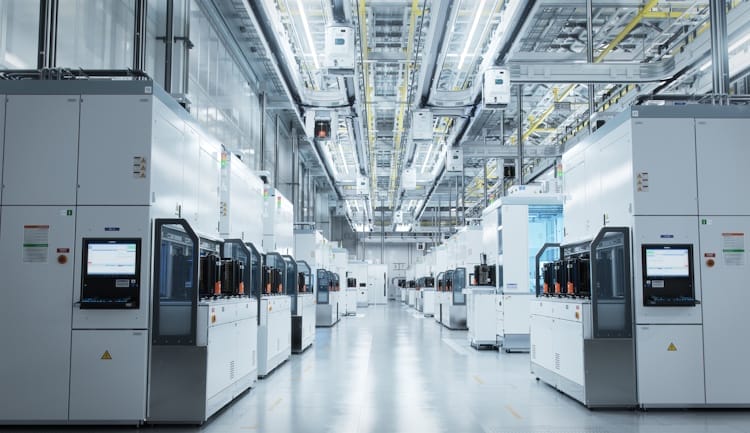
The Role of Air Distribution in Semiconductor Manufacturing
Air distribution is critical in semiconductor fabs because even microscopic airborne particles can damage chips, reduce yield, and interrupt production reliability. In these environments, clean air is an essential “tool” used for dependable fabrication.
Why the Semiconductor Market Raises the Stakes For Air Distribution
In 2025, global chip sales reached about $790.7 billion. Industry forecasts for 2026 are near $975 billion. Capacity and output are being driven to breakneck speed. Similarly, semiconductor infrastructure is experiencing unprecedented growth. 2025 was the all-time high at $125.5 billion, reflecting a continued investment in this market.
As demand grows, the cost of underperformance also increases. In microelectronics environments, where tighter process windows and higher-value output leave less room for contamination, air distribution is essential, from your ceiling system to your HVAC grilles.
Required reading: Learn must-know terms to understand air distribution and filtration.
How Air Distribution Contributes to Fab Plant ROI
Semiconductor devices and equipment are highly susceptible to chemicals, bacteria, and even dust. When defects occur due to air quality, time must be spent on refabrication, troubleshooting, and overall process interruptions. Uptime is essential for any manufacturing facility, but it is critical in an environment where competition makes each chip a valuable asset for business growth. Contamination control has financial implications during each hour of fab operation.
Although air distribution doesn’t bring in revenue, it protects your business investment to ensure yield and uptime aren’t hindered by unwanted airborne particles. FFUs, diffusers, HEPA or ULPA filters, and ceiling grids all contribute to how clean air is delivered consistently across critical zones.
When those components are engineered as an integrated system, along with products like supply grilles and return grilles, they help fabs reduce defect exposure, support stable operations, and better protect the return on a major capital investment in one of the world’s most robust markets.
- FFUs play a central role by pairing fan-driven airflow with high-efficiency distribution at the point of delivery.
- Diffusers affect how air enters in a chosen pattern. Poor air distribution can undermine otherwise capable distribution by introducing significant volume or uneven performance across the cleanroom.
- HEPA and ULPA filters remain proven core air filtration media.
- Ceiling grids provide the structural backbone that makes air distribution product- integration possible.
- HVAC grilles, including supply and return grilles, help control air volume.
Keep up-to-date: Custom HVAC Trends You Should Be Tracking Now
Key Considerations When Designing Air Distribution Systems
Effective air distribution design requires early coordination with a highly capable manufacturer, especially on semiconductor projects where room performance, ceiling infrastructure, and project construction are fully linked.
For AEC teams, that means the foresight to see beyond individual product categories. FFUs, diffusers, filters, and ceiling grids have to work within a larger design logic that includes structural coordination, access requirements, maintenance strategy, and future adaptability. If those relationships are not considered early, the project is more likely to face avoidable complexity.
AEC teams should also consider scalability. Many fabs evolve over time, and air distribution systems can be designed flexibly with a suspended ceiling grid that allows for expansion and integration of new systems and products. Ceiling grids also provide maintenance access to ensure effective service and replacement planning without disruption to core operations.
Go deeper: What every air distribution manufacturer wants your AEC team to know.
An Investment In Air Distribution Is an Investment In Chip Fabrication
Air distribution is foundational to semiconductor manufacturing because it protects an environment that high-output production depends on.
To support yield, preserve uptime, ensure expensive assets aren’t damaged, and keep operations running strong, an integrated air distribution system is a critical investment.
For fab operators and AEC teams, look for a manufacturer that can provide high-performing systems and products, including supply grilles and return grilles. Bring this team in early to ensure this valuable solution is properly integrated. In a market where microelectronics capacity is expanding, and every unit of successful production carries meaningful value, attention to contamination control helps protect both the environment and your return on investment.
Further reading: Are all custom HVAC brands essentially the same?