
Healthcare, Pharmaceuticals, and Microelectronics Depend on Clean Air
Hospitals, pharmaceutical manufacturing, and semiconductor cleanrooms don’t live by a traditional view of air distribution. Although comfort for building occupants is important, this isn’t the top priority for these industries.
For them, air distribution is viewed as a performance requirement. Air movement, filtration, volume, pressure, and ventilation directly affect business goals. Best-in-class HVAC critical environments means delivering the right airflow pattern in the right place, supported by filtration and pressure strategies that match the room’s purpose.
In healthcare, HVAC supports controlled air over procedure zones. In pharma, it supports contamination control. In semiconductors, it supports stable conditions that protect production.
What Is Air Distribution for Critical Environments?
In critical environments, air distribution is the planned delivery and removal of air to filter unwanted particles, control airflow direction, and create environmental conditions. Because this infrastructure has the power to impact business outcomes, air distribution becomes a set of decisions an AEC team should make early.
A team planning to build a room for medical procedures, pharmaceutical manufacturing, or microelectronic fabrication must consider:
- Equipment: Decide what air distribution systems and products are critical to ensure a room fulfills its purpose.
- Airflow pattern: Consider what pattern is essential to room processes and how that pattern is maintained across the space.
- Filtration strategy: Determine what filter level is required, how it’s sealed, and how it’s accessed and tested over time.
- Airflow volume: Understand your air distribution products’ airflow volume to maintain ideal conditions in the environment.
- Integration and serviceability: Choose a ceiling system that supports other key goals, including lighting, equipment mounting, and access.
- Compliance: Know what regulations, guidelines, standards, and owner requirements apply, and how the design supports those expectations.
Air Distribution Is a System, Not a Single Device
Diffusers, filters, fan filter units (FFUs), ceiling and grid systems, and other products each play a role. The performance you get depends on how well those parts work individually and collectively — along with the experience your air distribution team brings to the table.
Air Distribution in Hospitals and Other Healthcare Settings
Healthcare spaces with infection-prevention priorities are built around creating predictable environments. The goal is to deliver controlled air where it matters.
What You’re Protecting in Hospitals and Healthcare
Hospitals demand superior air distribution because airflow patterns and filtration help reduce infection risks, especially in operating rooms and procedure areas.
Industry-Specific Concern: Integration
A team must ask: where must air be delivered in a controlled way, and what does the ceiling need to support to make that possible?
In many hospital projects, the ceiling system can serve as a comprehensive solution for a critical environment, such as an operating room. It becomes the infrastructure that helps teams reconcile airflow needs with limited ceiling space and equipment requirements.
Hospital air distribution tip: Look for a structural operating room ceiling system that allows for seamless integration with other priorities alongside air distribution, such as a low-profile common plenum, configurable laminar flow diffusers, and integrated tunable/dimmable LED lighting options.
Air Distribution in Pharmaceutical Manufacturing
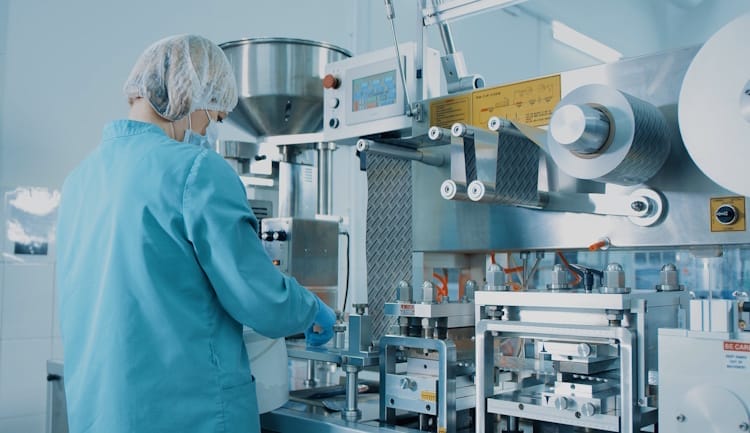
Much like healthcare facilities, the goal for air distribution in pharmaceutical manufacturing plants is to ensure filtered, ultra-clean air covers spaces used for production.
What You’re Protecting in Pharmaceutical Plants
An air distribution plan has to support contamination control and repeatable results over time. Contamination leads to product losses, downtime, and potential legal and regulatory risk.
Industry-Specific Concern: Filtration Quality
AEC teams designing for pharma should ask how they will ensure filtration after maintenance, filter changes, and process changes without introducing contamination risk.
In pharmaceutical manufacturing, contamination is a very real possibility. Air distribution has to support a consistent air filtration plan because even small lapses in sealing, access, or maintenance can lead to unwanted outcomes.
Consider a leading air distribution manufacturer that builds a range of fan filter units, alongside HEPA and ULPA filters. Their team will work with you to determine which products you should pick for the pharmaceutical industry.
Trust proven equipment: FFUs and filters from a first-class team are specifically designed for maximum performance, along with rigorous verification and testing, prior to building out your critical environment. A trusted manufacturer will likely design FFUs and filters that have already proven their value in facilities like yours, including nationally recognized businesses.
Air Distribution for Semiconductor Cleanrooms
Semiconductor cleanrooms demand best-in-class air distribution during the process of fabrication with sensitive materials.
What You’re Protecting in Semiconductor Fabs
Semiconductor cleanrooms must be designed to protect against particles, which quickly create defects, product losses, and dissatisfied partners downstream.
Industry-Specific Concern: Construction and Installation
The construction and installation phase is one of the most vulnerable times for risk exposure. Stick-built, on-site work typically means more time in the space, more trades coming and going, more materials arriving piecemeal, and more opportunities for dust, debris, and rework.
A modular approach flips that equation. Air distribution teams that take a modular approach build more of the ceiling grid in a controlled factory environment with repeatable quality checks. Then, the product is shipped in prebuilt sections for faster, cleaner assembly to reduce the time your cleanroom is exposed to disruption.
Semiconductor air distribution tip: For semiconductor facilities, predictability matters as much as performance. Look for a manufacturing team that prioritizes modular construction. A modular system supports future revisions. When tools, bays, or airflow strategies evolve, reconfiguration is less likely to require major rebuild, helping you protect uptime and keep the cleanroom aligned with production needs.
What Your Team Should Decide Early for Air Distribution
The following questions can be used in conversation with your air distribution system and product manufacturer. Go into that discussion having answered these questions:
- What is the goal for our critical environment?
- What are the internal or regulatory expectations for filtration?
- What products do we need to support distribution and filtration?
- What ceiling elements will compete for space, and what access clearances are non-negotiable?
- What construction and installation needs do we have?
When you do the groundwork, you have a better chance of expediting your project and ensuring essential specs align with your chosen manufacturer’s products.
FAQs About Air Distribution
Q1. What is air distribution?
Air distribution is how air is supplied and removed from a space to achieve the intended airflow pattern, temperature, pressure relationships, and particle control.
Q2. What are air distribution systems?
Air distribution systems include the equipment and design strategy to deliver and remove air, which often involves ceiling integration, supply and return devices, filtration, controls, and service access.
Q3. What is air distribution for critical environments?
Air distribution for critical environments is designed to control airflow direction and contaminant movement in spaces where contamination risk, process integrity, or production yield is at stake.
Q4. What is air distribution for hospitals typically trying to accomplish?
Hospitals often prioritize controlled airflow over high-risk zones, increased space and convenience for professionals, and maintainability that supports clinical uptime.
Q5. Why do pharmaceutical manufacturing spaces require air distribution solutions?
Because contamination drives losses, downtime, and risk. Air distribution helps maintain controlled airflow direction, filtration, and volume, so critical processes can run consistently and be verified over time.
Q6. Why do semiconductor cleanrooms care so much about air distribution?
Semiconductor fabrication involves producing several microscopic and highly sensitive components, including transistors and diodes. When particles affect these parts, semiconductor chips will not function as intended.